
Dubai New Street Signs 2026: 186 Areas to Get Colour-Coded Signs
Ask anyone who has lived in Dubai for a while how they give directions, and you’ll usually get landmarks instead of addresses. “Turn left after the petrol station.” “It’s the villa with the green gate.” That habit might finally get a little less necessary.
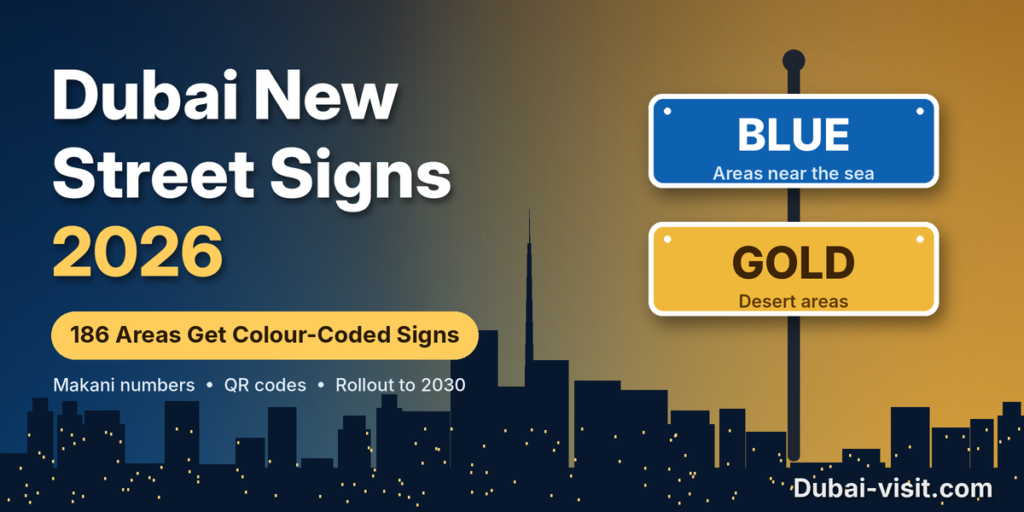
On 7 October 2026, Dubai announced a new addressing system with colour-coded signs, redesigned house plates and QR codes. It covers 186 areas across 19 sectors and will roll out in phases until 2030. Here’s what is changing, what the colours mean, and which neighbourhoods get theirs first.
What is actually changing?
Three things, all designed to look like they belong together:
- Area and sector signs that tell you which neighbourhood you’ve just driven into.
- Internal street name signs inside those neighbourhoods.
- House number plates with the same colour scheme as the streets around them.
The Supreme Committee for Urban Planning is leading the project with the Roads and Transport Authority (RTA) and Dubai Municipality. According to Emirates 24|7, the design came from a specialist wayfinding and addressing consultant, and the aim is for signs to do more than point the way. They’re meant to become part of how each area looks and feels.
This is just the start of the new identity. The RTA says it will later reach bus stops, mobile apps and area map boards too.
What do the colours mean?
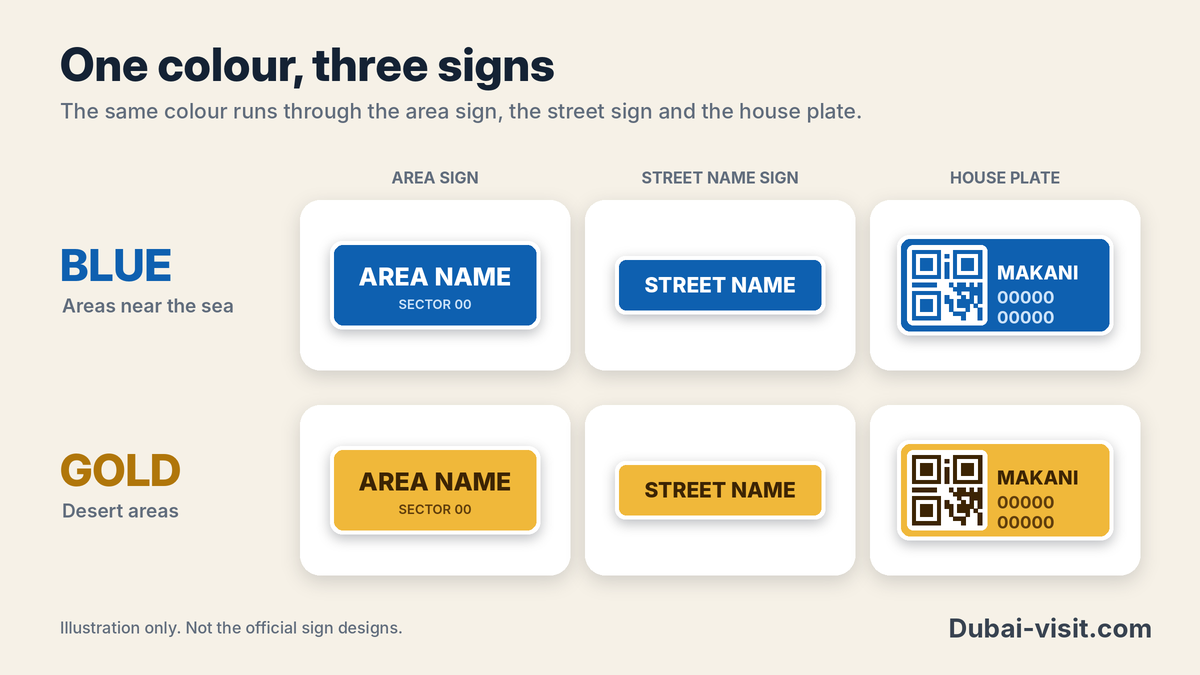
The system uses five colours, and each one is picked to reflect the character of the area it belongs to. Two examples have been spelled out so far:
- Blue for areas close to the sea.
- Gold for desert areas.
The other three colours haven’t been detailed in the launch coverage, so check the RTA’s announcements for the full key before you start guessing. What is clear is that the colour carries across the area sign, the street signs and the house plates. Cross into a neighbourhood with a different colour and you’ll know you’ve left the last one behind, even before you read a word.
Which areas get the new signs first?
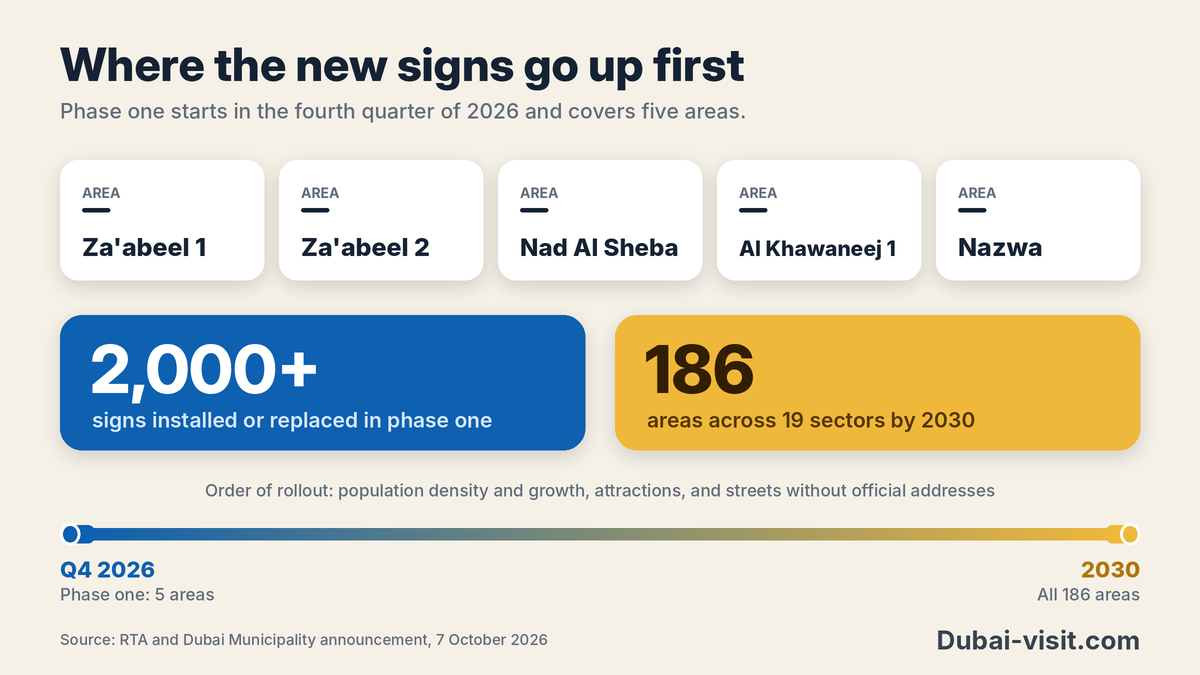
The first phase covers five areas, and more than 2,000 signs will be installed or replaced there starting in the fourth quarter of 2026, per Gulf Business:
- Za’abeel 1
- Za’abeel 2
- Nad Al Sheba
- Al Khawaneej 1
- Nazwa
If you’re staying or driving around any of these, you could be among the first people to see the new look in real life.
Makani numbers and QR codes on house plates
This is the part that might change daily life the most. Each new house plate will show the property’s Makani number, which is Dubai’s location identifier, along with a QR code. The plate’s colour matches the area and street signs, and the designs have been approved by both the RTA and Dubai Municipality.
Scan the QR code and you can pull up details about the area and sector, the meaning behind street and area names, and nearby points of interest. Think of it as a small local guide stuck to the gatepost. Delivery drivers, guests and curious visitors all get something out of it, per Radio 4 FM.
When will your area get its signs?
The rollout runs in phases from the fourth quarter of 2026 through 2030. That’s a long runway for 186 areas, so it helps to know how the order gets decided. The RTA and Dubai Municipality set criteria that look at:
- Population density and growth
- The presence of residential and tourist attractions
- How many streets still don’t have an official address
Only the first five areas have been named so far, which leaves 181 waiting for their turn. If your neighbourhood isn’t on the list yet, it could be months or years before the new signs appear.
What it means for visitors and residents
If you’re visiting. Don’t expect to see the new signs everywhere on your next trip. For now, the change is limited to five areas, so most neighbourhoods will look the way they always have. Where the signs do appear, the colours give you a quick read on where you are, and the QR codes add a bit of local context. Your phone’s map app will still do most of the heavy lifting.
If you live here. No action has been announced for homeowners. The RTA and Dubai Municipality will be the ones to share any official guidance, so keep an eye on their channels as your area’s turn approaches.
If you run a business or deliver for a living. Clearer addresses and consistent plates should make drop-offs and customer arrivals easier, which should help delivery services too.
Quick answers
1. How many areas will get the new signs?
186 areas across 19 sectors, by 2030.
2. When does it start?
The first phase begins in the fourth quarter of 2026.
3. How many signs go up first?
More than 2,000, across Za’abeel 1, Za’abeel 2, Nad Al Sheba, Al Khawaneej 1 and Nazwa.
4. What do the colours stand for?
Five colours reflect each area’s character. Blue marks areas near the sea and gold marks desert areas.
5. What’s on the new house plates?
The property’s Makani number and a QR code, in the colour of the area.
The bottom line
It’s a small change on paper: new signs, new colours, a QR code on the gate. But in a city that grows as fast as Dubai, a clearer address system makes a real difference for residents, visitors and anyone trying to find a villa down a side street. Give it a few years and “the one with the gold sign” might actually be useful directions.
Sources
- Urban Planning Committee, RTA and Dubai Municipality launch new addressing identity (WAM)
- Dubai to get new street signs with colours inspired by each area (Khaleej Times)
- Dubai is changing its street signs, here are the five areas getting them first (Gulf Business)
- Dubai’s new colour-coded street signs across 186 areas (Emirates 24|7)
- Dubai addressing system gets new signs, colours and QR codes (Gulf News)
- Dubai street signs and house numbers are changing (Arabian Business)
- Dubai to introduce colour coded street signs (Radio 4 FM)