
UAE Salt, Sugar and Fat Limits by 2030: Food Rules Explained
Next time you pick up a packet of chips or a loaf of bread in the UAE, there’s a good chance the recipe is about to change.
On 6 October 2026, the Ministry of Health and Prevention announced limits on how much sodium, sugar and fat certain packaged foods can contain. Companies get time to adjust, but the final limits have to be met by 31 December 2030. Here’s what the rule says, which foods are affected and what it means for what ends up in your trolley.
So what has actually changed?
Under the new Cabinet resolution, a list of packaged foods now has maximum levels of sodium, sugar and, in the case of bread, fat. The limits come down in two steps: a first-phase limit, then a tougher final one.
The rule covers packaged food made in the UAE and imported food. It also covers the businesses that handle it, from the factory to the shelf and the serving counter, including companies in free zones. Food made only for export is left out, unless it is also sold here.
The ministry says the aim is to bring down obesity and other diseases linked to unhealthy food.
Which foods have limits, and how low do they go?
Here are the caps per 100 g. The first number is what companies must reach first, and the second is the final target for 2030.
| Food | Nutrient | First phase | By 2030 |
|---|---|---|---|
| Leavened bread | Sodium | 444 mg | 370 mg |
| Leavened bread | Total sugars | 6 g | 5 g |
| Leavened bread | Total fat | 8.4 g | 7 g |
| Flat bread | Sodium | 384 mg | 320 mg |
| Flat bread | Total sugars | 6 g | 5 g |
| Flat bread | Total fat | 8.4 g | 7 g |
| Sweetened milk drinks (including milk alternatives) | Total sugars | 9.6 g | 8 g |
| Sweetened or flavoured yogurt and laban | Total sugars | 12 g | 10 g |
| Salted crackers | Sodium | 696 mg | 580 mg |
| Salted nuts and seeds | Sodium | 336 mg | 280 mg |
| Pretzels | Sodium | 912 mg | 760 mg |
| Extruded snacks and chips (potato, sweet potato, vegetable or grain) | Sodium | 564 mg | 470 mg |
| Spreadable processed cheese | Sodium | 864 mg | 720 mg |
| Other processed cheese | Sodium | 1,200 mg | 1,000 mg |
Two things to notice. The limits are for sodium, not salt. Salt is roughly 2.5 times the sodium number, so 444 mg of sodium is about 1.1 g of salt. And fat only gets a limit in bread.
When does it start?
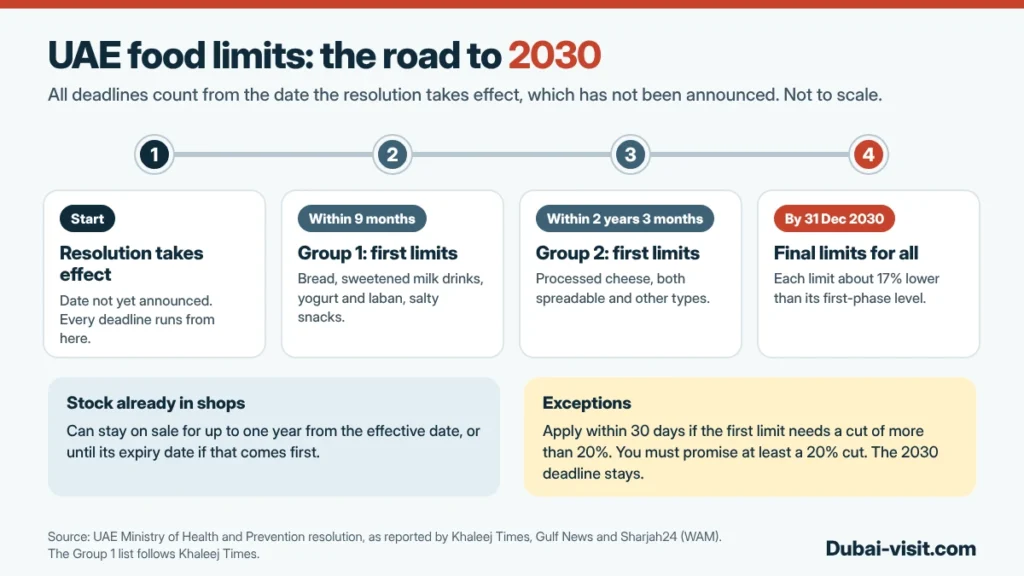
Bread, sweetened milk drinks, yogurt and laban, and salty snacks have nine months from the date the resolution takes effect to hit the first limits. Processed cheese gets longer: two years and three months. Everything has to meet the final numbers by 31 December 2030.
The catch is that the announcements don’t say when the resolution takes effect, so there are no firm calendar dates for the first phase yet. Once that date is confirmed, working out the real deadlines is easy.
A few more details:
- Products already in shops can stay on sale for up to a year, or until they expire, whichever comes first.
- A company that would have to cut an ingredient by more than 20% to meet the first limit can apply for an exception within 30 days. It has to promise a cut of at least 20% anyway, and the 2030 deadline doesn’t move.
What happens to companies that don’t comply?
The penalties are aimed at food businesses, and they range from a warning up to losing the licence:
- A fine of AED 5,000 to AED 500,000
- Closure for up to six months, which can be renewed
- Cancellation of the licence or approval
How strict it gets depends on how serious the breach is and whether it has happened before. Federal and local health authorities will do the checking, and companies have to hand over the data and documents needed. The Cabinet will publish the full list of violations and fines separately.
What does this mean for you?
Nothing changes at the till tomorrow. Over the next few years, you should see familiar products reformulated a little at a time, with less sodium, sugar and fat, while older stock is cleared from shelves. The announcements don’t mention any new labels.
In the meantime, the advice from health experts quoted by The National is simple and familiar:
- Read the label and compare products per 100 g.
- Keep an eye on portion size. A low number per 100 g doesn’t help much if you finish the whole bag.
- If a label shows sodium, multiply it by about 2.5 to see roughly how much salt that is.
[Add your own touch here: one or two lines on a product you’ve checked, or how you read labels when you shop. Delete this note before publishing.]
Quick answers
1. Does this apply to imported food?
Yes. Imported and locally made packaged foods are both covered, including those handled in free zones.
2. Which foods get a fat limit?
Only bread, at 8.4 g per 100 g at first and 7 g by 2030.
3. Is salt the same as sodium?
Not quite. Sodium is one part of salt. Multiply the sodium figure by about 2.5 to get the salt.
4. What are the fines?
AED 5,000 to AED 500,000 for food businesses, with closure or loss of licence possible.
Sources