
Dubai (UAE) Driving Test Score Marks: How Scoring Works and How to Pass
Scored 75% on your driving test and think you’re done? From 1 January 2027, not necessarily. The UAE is keeping the 75% minimum for both the theory and the practical test, but one dangerous mistake can now fail you no matter how many marks you’ve collected.
If you’re learning to drive in Dubai, or you’re moving here and will have to sit the test sooner or later, it pays to know how the scoring actually works. Below I walk through the stages of the test, what the pass marks mean, the slip-ups that cost people the most, and what you can do to avoid paying for a second attempt.
What the Dubai driving test involves
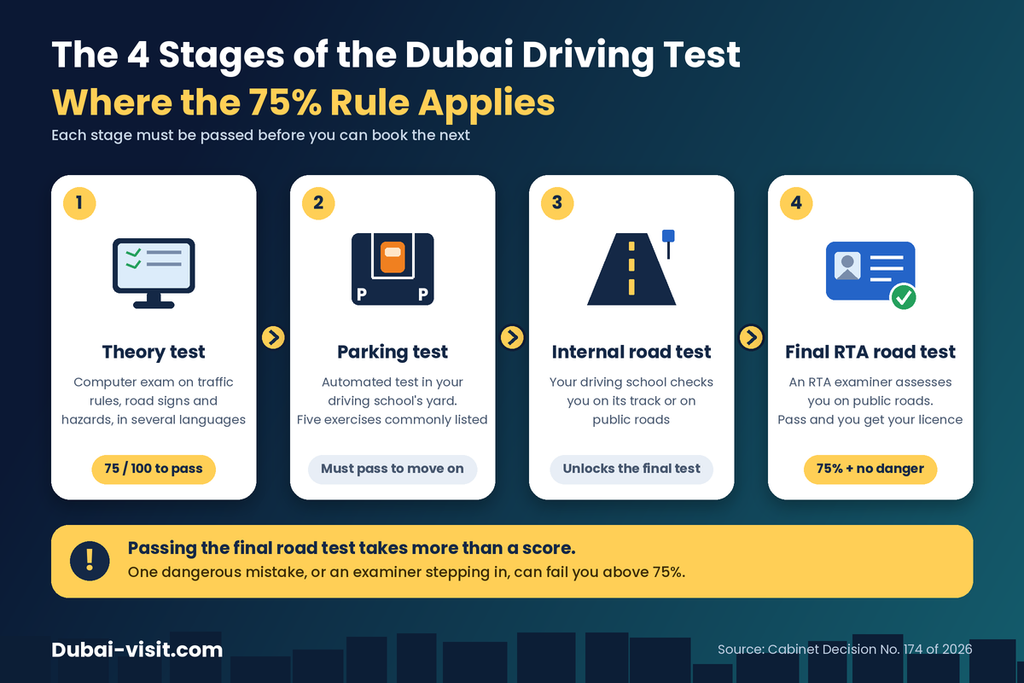
You can’t skip ahead. Each stage has to be passed before you can book the next, and the work is split between your driving school and the Roads and Transport Authority (RTA). For a new learner, the usual route looks like this:
- Theory test. After your classroom or online lessons, you sit a computer-based exam on traffic rules, road signs and spotting hazards. It’s offered in several languages.
- Parking test. This one is automated and takes place in your driving school’s yard. Guides commonly list five exercises: slope parking, an emergency brake, 60-degree angle parking, 90-degree garage parking and parallel parking.
- Internal road test. Your driving school checks you out on its own track or on public roads. Pass it and you’re eligible for the final test.
- Final RTA road test. An RTA examiner assesses you on public roads. Pass this and you get your licence.
When it comes to scoring, the theory test and the final road test are the two that matter most, because those are the ones the new national rules put a 75% minimum on.
So what score do you actually need?
Seventy-five percent, in both tests. The practical test then adds a safety rule on top. All of this comes from Cabinet Decision No. 174 of 2026, which was published in the UAE Federal Official Gazette on 6 October 2026. It approves the Executive Regulation of Federal Decree-Law No. 14 of 2024 on traffic regulation.
| Test | Minimum to pass | What else to know |
|---|---|---|
| Theory (Article 65) | 75 out of 100 marks | You must clear it before moving on to the practical assessment |
| Practical (Article 68) | 75% of the total evaluation marks | You can still fail if you cause actual or potential danger, or if the examiner has to step in, by voice or by hand |
| Retest (Article 69) | Not applicable | A fail gets you another test date, with no national waiting period set |
A few things are easy to get wrong here.
- The 75% mark isn’t new. An older rule, Ministerial Resolution No. 130 of 1997, already asked for 75% and already listed dangerous errors that could fail you. What the 2027 text does is spell out, more plainly, that a good score doesn’t cancel a dangerous mistake.
- There’s no single national mark sheet. Each licensing authority approves its own testing plan and can add criteria. So the exact points per manoeuvre in Dubai are decided by the RTA and your driving school, not by the federal text.
- Older guides may quote a different theory mark. You’ll still see plenty of pages saying 65%, or 23 correct answers out of 35. Treat those with caution and check the current format with the RTA before you book.
When does it kick in? On 1 January 2027. Until then the existing framework applies. Khaleej Times reports there’s no exemption for people who started lessons earlier, so if your test falls on or after that date, prepare for the new standard.
The mistakes that can sink you at any score
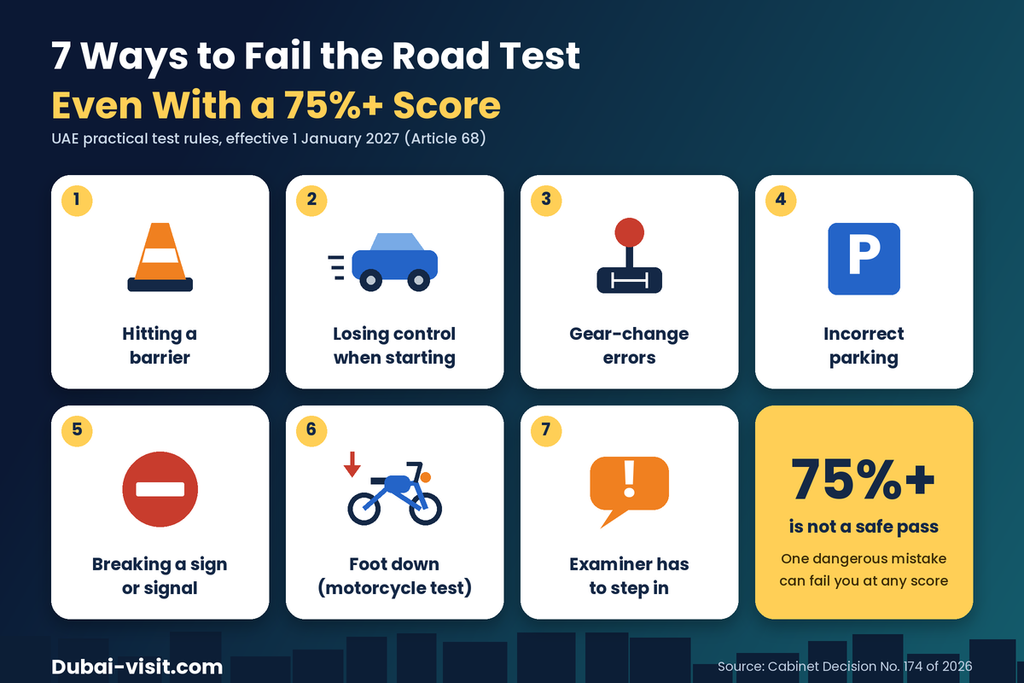
Article 68 names six errors that count as potential danger and can fail the practical test even when your marks are above 75%, as Gulf News reported. Add the examiner having to intervene, and you have seven ways to fail with a good score.
| Mistake | What it looks like on test day |
|---|---|
| Hitting a barrier | The car’s body or wheels touch a marked barrier or boundary |
| Losing control when starting | The car lurches or rolls because you didn’t have it under control |
| Gear-change errors | A bad shift that affects how safely the car is operated |
| Incorrect parking | You don’t stop or position the car in the designated space |
| Ignoring traffic rules | You break a traffic sign or signal |
| Motorcycle foot-down | A rider’s foot touches the ground while riding (motorcycle test only) |
| Examiner intervention | The examiner has to speak up or physically step in to prevent danger |
There are also the everyday slips that learners in Dubai tend to make. A Gulf News piece on failed road tests mentions entering a no-entry zone, stopping inside a yellow box junction, not giving way at a roundabout, poor lane discipline, skipping mirror and blind-spot checks, and shaky vehicle control. It also points out that the RTA hasn’t published recent official pass rates, so be careful with any pass-rate figure you see quoted online.
If you fail: retakes, fees and deadlines
Failing the practical test isn’t the end of the road. Article 69 says you’ll be given another test date, though the federal text doesn’t set a single waiting period or retest fee. For now, Dubai’s own arrangements are the better guide. Gulf News covered them on 19 October 2026, and they could be updated once the new rules start.
| What | How it works in Dubai at the moment |
|---|---|
| Standard RTA road test fee | Dh220 (Dh200 for the test plus a Dh20 Knowledge and Innovation fee) |
| Extra training before a retest | Four compulsory sessions at your driving institute, priced by the institute |
| Wait for a new slot | Up to 14 working days once the training is done |
| When to arrive | At least 30 minutes before your slot |
| Postponing | Online or via your institute, up to 24 hours before the test |
| Moving to an earlier date | Dh320 |
| Missing your test | You book again and pay the fee again |
| File deadline | Your training file is suspended if you skip a knowledge, yard or road test for six months |
You can rebook on the RTA website (rta.ae) or through your driving institute. Two more things to keep in mind: if your licence isn’t issued within a year of passing the road test, you’ll have to take an evaluation test, and some institutes charge extra for tests booked on public holidays.
How to protect your score on the day
Examiners work from the skills listed in Article 66, so that’s what you should practise. A few habits make the biggest difference:
- Know the car before you worry about the route. Starting, hill starts, smooth gear changes and controlled stops (including an emergency stop) need to feel boring. Losing control at the start is one of the listed fail triggers.
- Treat boundaries like walls. Reverse, parallel park and park between markings until you can place the car without touching a barrier or a line.
- Check mirrors and blind spots every single time. Before a lane change, a turn or pulling away, and indicate early.
- Follow every sign and signal. No-entry signs, yellow box junctions and roundabout priority are where learners often slip.
- Leave a safe gap. Examiners look at following distance and overtaking, so don’t rush or tailgate.
- Drop old habits. Drivers who’ve been on the road for years elsewhere often skip indicators or drive one-handed, according to the driving-school expert Gulf News spoke to. Those habits cost marks here.
- Deal with nerves. The same expert says nervous learners forget what they know, and suggests driving simulators, which a growing number of Dubai schools now use, to build confidence.
- Ask for extra practice where you struggle. If one manoeuvre keeps going wrong in lessons, book more time on it before you book the test.
Quick answers to common questions
1. What score do I need to pass?
From 1 January 2027, at least 75% in both tests: 75 out of 100 in theory, and 75% of the total marks in the practical.
2. Can I really fail with 75% or more?
Yes, in the practical test. If you cause actual or potential danger, or the examiner has to step in, you can fail whatever your score is.
3. I started lessons before 2027. Do the new rules still apply to me?
Probably, if your test is on or after 1 January 2027. Khaleej Times reports there’s no exemption for learners who started or booked earlier. Tests before that date fall under the existing framework.
4. Will touching a kerb or barrier fail me?
Article 68 lists contact with a marked barrier or boundary as a potential-danger mistake, so treat it as serious.
5. Is the marking sheet the same at every driving school?
No. The regulation doesn’t set one national marking system. Each licensing authority approves its own testing plan and can add criteria.
6. How long do I wait to retake the test in Dubai?
The federal text doesn’t set a standard wait. Recent Dubai reporting says you may wait up to 14 working days for a slot after finishing four compulsory training sessions.
The bottom line
Think of 75% as the ticket to get in, not the finish line. From 1 January 2027, how safely you drive during the test counts as much as your total. Work on controlling the car, parking cleanly, checking everything around you and obeying every signal. Before you book, confirm the latest procedures, fees and booking rules with the RTA or your driving institute, because details can change. This guide is a starting point, not legal advice.
Sources
Checked on 28 October 2026.
- Gulf News: New UAE driving test rules from 2027
- Dubai Standard: UAE Driving Licence Rules 2027
- Khaleej Times: Why scoring 75% may still not be enough to pass
- Time Out Dubai: UAE introduces automatic fail rule for driving tests
- Gulf News: Failed your RTA driving test? How to rebook and what it costs
- Gulf News: Most common reasons for failing the RTA road test
- Bayut: Your ultimate guide to the Dubai driving licence (stage overview)